A Round Ball or an Oval One: What Shape Invites
Round ball or oval ball play changes how a game moves. Compare their strengths and choose the shape that suits rolling, catching, carrying or loose-ball play.
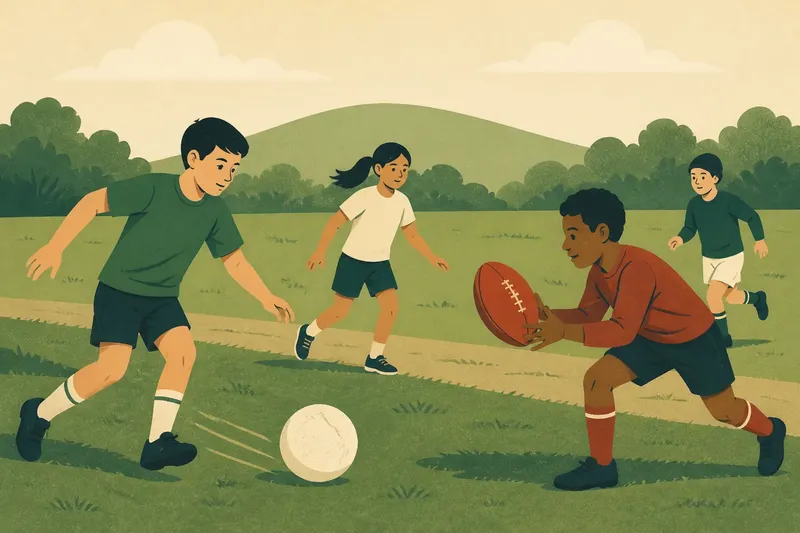
Which ball suits the game you want: one that rolls into a pass, or one that makes a catch and an uncertain bounce part of the exchange? Round ball or oval ball play begins with shape, but the useful choice depends on the surface, players and kind of movement the group wants.
A sphere usually rolls in a more readable way across firm, level ground. An elongated ball can turn or rebound at an angle because different parts of it meet the ground. Neither shape dictates the rules; each simply makes some actions easier to anticipate than others.
A round ball suits rolling passes and close control
A spherical ball presents a similar profile as it turns. On a level, firm surface, a push can become a steady roll, allowing players to guide it with a foot, hand, stick or bat and follow its route. Grass, gravel, a slope or a wet patch can still disturb that path.
This makes a round ball a natural fit for games built around ground passes, movement into open space and repeated touches. The sender can choose an angle, while the receiver decides where and how to meet the ball. Players can also lift or throw it, but those actions require a different kind of timing from a controlled roll.
If a round ball veers unexpectedly, inspect the surface before blaming the pass. A shallow dip or loose grit may redirect it; spin can also affect its route. Roll it slowly across clear ground, then across the troublesome patch. If it changes direction at the same place, the surface is part of the problem.
For ground-based play, choose the round ball when players need a route they can follow and adjust with successive touches.
An oval ball suits catches, carries and loose-ball contests
An elongated ball has a long axis and pointed ends, so its landing angle affects what happens next. A side-first landing may rebound differently from an end-first one. The ball’s construction, the way it was sent and the surface all contribute, which makes its bounce harder to read than a steady roll.
That uncertainty can make catching, carrying and recovering the ball central to play. Hands help secure it, while players may use their bodies to shield it from a poor bounce or an opponent. A pass through the air asks the receiver to judge the ball’s rotation and approach as well as its destination.
If an oval ball escapes after a bounce, watch which part meets the ground first. A gentle drop onto clear, level ground can reveal how its orientation affects the rebound. The aim is to notice what changed, not to force a particular technique.
Choose the oval ball when the group wants catching, carrying or a loose-ball chase to shape the next move, rather than relying chiefly on ground control.
Match the ball to the surface and the action
The comparison is practical, not absolute. A round ball is usually easier to follow when rolled over a suitable surface; an oval ball creates more variation in its bounce and rewards players who can secure it. A rough or sloped playing area can make either object difficult to control, while the intended action may matter more than the shape alone.
- If the game depends on ground passes, check whether the surface is firm and reasonably even; if it is, choose a round ball, and if it is not, clear a safer, smoother patch or change to a slower activity.
- If players need to carry and secure the ball, check that its size and surface suit their hands; if it does, an oval ball may fit the activity, and if it does not, use a more comfortable ball or adapt the rules.
- If the ball repeatedly changes direction at one spot, check for a dip, loose grit or slope; if you find one, move the play or avoid that line, and if the ground is clear, reduce the force and watch the ball’s spin.
- If a catch feels rushed, check the time and space available to the receiver; if either is limited, send an easier, more visible pass or give the receiver more room.
- If players crowd every loose ball, check whether the group expects a catch, a controlled roll or a contest; if nobody agrees, name the intended action before restarting, and if the crowding remains, spread the starting positions.
- If the chosen ball is uncomfortable or unsuitable for the players, check its feel and the activity’s equipment guidance; if it is a poor fit, choose an appropriate alternative, and if its suitability is unclear, consult the manufacturer’s instructions or the relevant local rules.
Say a group has a patchy lawn, a sphere and an oval ball, and wants a game based on passing along the ground. They first try the sphere on a clear strip, where it rolls towards a waiting player; on the rough patch it veers, so they move the passing lane to the clear strip. They then try the oval ball along the same lane, where its wobble makes the intended ground pass harder to follow. For the game they want, the sphere is the clearer fit; if they instead wanted catches and loose-ball recovery, the oval ball would make more sense.
Rules and shared expectations give the shape its meaning
Shape alone does not make a sport. Rules decide whether players may carry the ball, how it can be passed and what happens when it leaves the playing area. A sphere can be carried, and an oval ball can be rolled; a particular game may simply make one action more central.
In informal play, unspoken expectations can cause more confusion than the ball. If everyone expects a round ball to stay on the ground, picking it up may look like a breach. If the group expects an oval ball to be caught, a deliberate roll may seem like a mistake. Agreeing on the intended action turns possibility into a move that counts.
Before restarting a stalled game, decide whether the group wants ground passes, catches or a contest for a loose ball. A brief agreement is more useful than blaming the equipment for a rule nobody stated.
Which ball suits your game best?
Why does a round ball roll more steadily?
A sphere keeps a similar profile against the ground as it turns, so it can roll without a long axis tipping it onto a different face. Its route can still change because of spin, slope or uneven ground.
Why does an oval ball bounce unpredictably?
Its elongated body and pointed ends make the landing angle matter. The ground and the way the ball was sent can add further changes in direction.
Can either shape be used for different kinds of play?
Yes. Players can carry or throw a sphere, and they can roll an oval ball. The shape makes some actions easier to read, while rules and group expectations decide which actions belong in the game.
What should a group do when the ball keeps escaping?
Reduce the force and try a clear patch of ground, then watch whether the route changes before or at contact. If it changes at one spot, inspect the surface; if not, adjust the send or agree on a more suitable way to receive the ball.
For round ball or oval ball play, choose according to the next move the group wants to make. A sphere favours readable rolling routes; an oval ball gives catches, carries and recovery more influence. Before choosing, consider the surface and make the intended style of play clear, so the shape creates interesting uncertainty rather than needless confusion.