The Club Badge, From Mark to Shared Emblem
Club badge meaning begins with a simple mark: learn how its design identifies a team, becomes a keepsake and gathers significance through shared use.
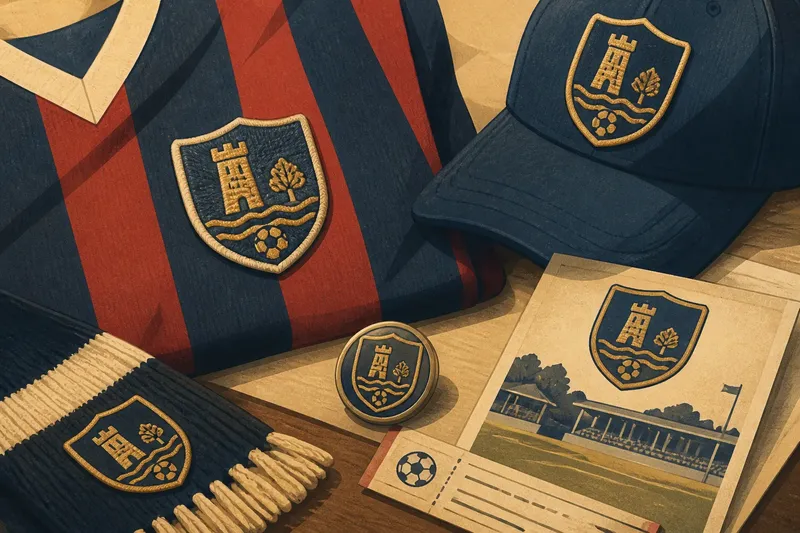
What makes a club badge feel like more than a picture on a shirt? Club badge meaning gathers around a small design through use: it identifies a side, travels on clothing and objects, and gives people a sign they can recognise as their own. The mark may be modest; the meanings attached to it rarely stay still.
A badge solves the problem of recognition
On a crowded pitch, a crest is a practical answer to a simple question: who is who? Colours and shirt patterns help, but a compact emblem can distinguish one team from another even when the kit is familiar in shape. On a programme, a ticket or a noticeboard, the same mark identifies the organisation without requiring a long name.
That usefulness shapes the design. A badge has to survive being reduced, embroidered, printed in one colour or viewed from across a room. Small details that look elegant on a screen may blur into a thicket of lines on fabric. A bold outline, a recognisable object or a distinctive arrangement often travels better.
Badges also make belonging visible. A crest on a sleeve turns an abstract affiliation into something other people can see, though it does not explain the wearer’s relationship to the club. The same shirt might belong to a player, a parent, a volunteer or someone who has never been near the changing rooms.
When considering a badge’s design, ask what remains legible at small scale. A symbol that survives reduction has more working life than a miniature illustration that needs an explanatory caption.
The shape carries a record of place and purpose
Sporting badges borrow from several visual languages. Shields suggest protection or formal identity; circles can hold a name neatly; stripes and bars echo kit colours; animals, tools and local landmarks point towards a place or an activity. These are conventions, not fixed rules. Their value depends on whether people recognise the reference and whether it can be reproduced clearly.
Some marks begin as practical identifiers and acquire a story later. A local building, plant or river may be included because it is familiar to the people who meet there. A ball or bat may state the sport plainly. Lettering can be more useful than a detailed scene where the club’s name needs to remain readable at a glance.
There is a difference between a symbol’s origin and its later interpretation. A design may have been chosen for convenience, inherited from an earlier insignia or adapted when an organisation changed its name. Members can still find meanings in it that were not part of the original decision. This does not make the later reading false; it makes the badge a record of how a community talks about itself.
To read an unfamiliar emblem, begin with what can be observed: its colours, shapes, words and repeated motifs. Treat a proposed explanation as a clue rather than a fact until it can be checked against the club’s own account.
Badges travel beyond the shirt
Once a mark is established, it tends to appear wherever a club needs to be recognised. It can be embroidered on a cap, printed on a programme, attached as a pin or reproduced on a scarf. Each surface changes the badge slightly. Stitching softens a fine edge; metal gives a pin weight; paper makes the mark temporary and easy to pass along.
That movement helps explain why badges become keepsakes. A pin or old shirt can stand for a particular season, a first visit, a family connection or a team someone played for. The object need not be rare or valuable. Its importance may rest on who gave it, where it was worn or the ordinary event it brings back to mind.
Imagine a supporter sorting a drawer and finding a cloth badge from a junior team they once watched a relative play for. They might remember the muddy touchline, then pass the badge to that relative or keep it beside a newer pin. The object has not changed, but its role has shifted from club identifier to a small carrier of family memory.
Keep a loose badge with a note of where it came from if that story matters. A few words can preserve context that the emblem alone cannot supply.
What do club badge meanings depend on?
Why do some club badges use a shield?
A shield is a familiar frame for an emblem and can make lettering or symbols feel contained. Its presence alone does not establish a particular history; the club’s own records or explanation may clarify why that shape was chosen.
Why do badges change?
A club may revise a badge to make it clearer on modern kit, reflect a change in identity or replace artwork that reproduces poorly. A redesign can also prompt disagreement because a familiar mark may carry personal memories as well as organisational meaning.
What makes a badge collectible?
Collectors may value a badge for its age, design, scarcity or connection to a particular team or event. Others care mainly about the people and occasions associated with it, which no catalogue description can fully capture.
How can an unfamiliar badge be identified?
Look for readable lettering, colours, sport-related objects and place names, then compare those clues with reliable club material. Similar shapes recur across sport, so a visual resemblance is a starting point, not an identification.
A shared emblem can invite disagreement
A badge belongs to an organisation in one sense: it is the mark used to identify it. In another sense, it belongs to the people who wear it, remember it and explain it to newcomers. Those claims can pull apart when a club redraws its crest, removes an old symbol or adopts a cleaner version for reproduction.
The disagreement is not always about taste. A changed detail may feel like a break with a local story, while a simplified design may be easier to stitch and recognise. Members can differ over which purpose deserves priority. A useful discussion separates the practical question—does the mark work on kit and print?—from the cultural one—what does this change ask people to leave behind or carry forward?
Say a community club replaces a complicated scene with a plain emblem for its shirts. Members who value the old drawing might ask for it to remain on archival material or a commemorative programme, while the newer version does the everyday work. That arrangement would preserve a visible link without requiring every use to serve as a museum label.
When a badge changes, keep the older version visible somewhere if its history matters to the people who use it. A small archive can make room for both continuity and practical revision.
The emblem means most in ordinary use
Grand explanations can make a badge sound more settled than it is. Its meaning is often built through repeated, unremarkable encounters: a child recognising the crest on a coach’s jacket, a volunteer pinning it to a noticeboard, a player seeing it on a teammate’s shirt. Repetition makes the mark familiar; shared activity gives that familiarity its social weight.
This is why a badge can matter even to someone who cannot explain its symbols. Recognition comes first. The crest marks a connection that may be based on playing, watching, helping, living nearby or inheriting an attachment from someone else. The emblem does not tell the whole story; it gives people a place to begin telling it.
Club badge meaning is therefore not locked inside the artwork. It grows through the objects that carry the mark and the relationships people attach to them. If you keep or pass on a badge, preserve its small piece of context as well as its shape: who used it, where it came from, or why it stayed in the drawer. That detail can be the part a future owner cannot read from the crest itself.