How Sporting Traditions Change Without Losing Their Meaning
Sporting traditions change over time as clubs adapt familiar customs. Learn how to identify a tradition’s purpose, include more people and decide what to keep.
What should a club keep when a familiar sporting custom no longer works as it once did? Sporting traditions change over time, often because people preserve a shared purpose while altering how they express it. The crowd may still gather before a match, even if the meeting has moved from a pub to a square or from the touchline to a group chat.
That distinction matters when a club, school or local league reviews a custom. Treating every detail as untouchable can turn a living practice into a reenactment; changing everything at once can leave people unsure what they are being asked to carry forward. A season gives a group time to observe a custom, try a careful adjustment and consider what changed.
Sporting traditions change over time by keeping a purpose in view
A tradition is not simply an old object or a repeated date. It is a practice people understand as belonging to their group: a song before kick-off, a shared meal after a fixture, a procession to the pitch or a particular way of welcoming new players. Its meaning lies partly in what people do and partly in what they say the act means.
Those parts can move at different speeds. A club may keep a pre-match gathering while changing who leads it. It may retain a familiar song but make room for a new verse, or replace a formal speech with a short welcome more people can join. The surface changes; the social purpose—marking a shared occasion, acknowledging newcomers or making a team feel local—continues.
Not every alteration counts as continuity. If a custom has become an obligation that excludes people or causes avoidable harm, its age is not a sufficient reason to preserve it. Nor does a new activity become a tradition merely because it happens repeatedly. People have to take it up, recognise it and give it meaning.
Start by asking what the custom helps people do together.
A season gives a club time to notice what it is preserving
A review can follow a playing season without turning tradition into a committee project with a form for every memory. The aim is modest: notice the custom in use, hear from the people involved and decide what to retain, adapt or let go. A notebook, a calendar and a few conversations are enough to begin.
- Before the season: Check when the custom happens, who takes part, which materials or spaces it uses, and what participants say it means. If the purpose is clear, record it as the basis for review; if accounts differ, note the disagreement and ask participants to clarify rather than calling the custom “the old way”.
- During the opening fixtures: Check who arrives, who leads, who hangs back and whether the custom depends on a particular person, room or piece of equipment. If participation is open and the activity works as intended, leave it unchanged for now; if people cannot join or the practice depends on an unavailable resource, record the obstacle and consider a limited adjustment.
- After several fixtures: Check how a junior player, a long-serving volunteer and a visiting supporter describe the same ritual. If their accounts share a purpose, use that as the part to preserve; if they diverge, record the differing meanings and invite the people affected to discuss them instead of treating seniority as the only authority.
- At the middle of the season: Check whether a specific problem can be addressed by changing one element. If so, explain the reason and try that limited adjustment at a suitable occasion; if the cause is uncertain or several elements would need to change together, gather more views before altering the custom.
- At the season’s end: Check what participants noticed, including people who joined recently. If the adjustment made the purpose easier to recognise or join, consider keeping it; if it created a new obstacle or obscured the custom’s meaning, revise it or return to the earlier form.
- Before the next season: Check that the decision and its reason are clear to participants. If the custom continues or changes, explain what people can expect; if it is retired, describe its former purpose and how that purpose will be handled now, rather than leaving members to infer the reason from silence.
This schedule gives a custom room to show its ordinary shape before anyone tries to improve it. A practice witnessed only on a special anniversary can seem more fixed than it is on a wet Tuesday evening.
Small changes can preserve the invitation behind a ritual
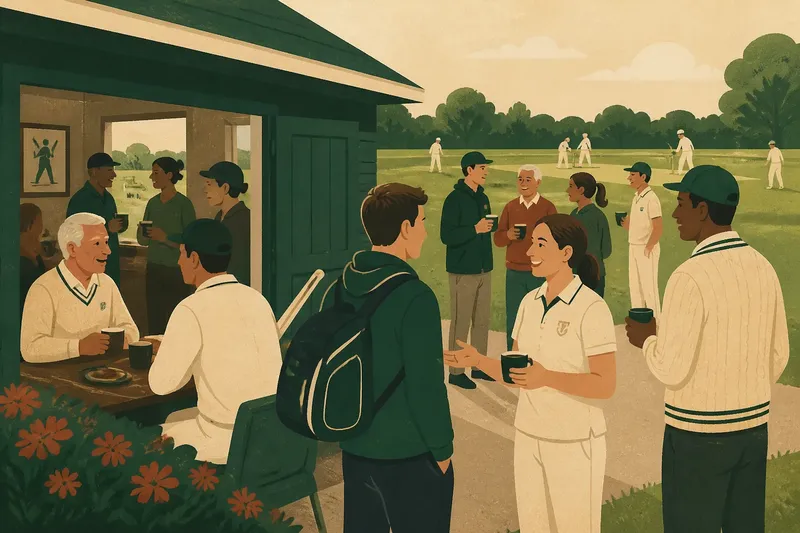
Imagine a community cricket club where tea after Saturday matches is served in a narrow pavilion room. In this invented situation, the starting point is that new players leave before tea because they do not know whether they are welcome. The organisers ask regulars and newcomers what the gathering means, then move the first part of tea to the open area beside the pavilion and ask a rotating pair of players to greet people. The expected observable result is that newcomers can see where to go while regulars can still recognise the post-match gathering.
The club then has a concrete choice: keep the welcome outside and serve the rest indoors, or use the larger area throughout. The purpose is not to preserve a particular arrangement of cups and chairs. It is to make the invitation visible while retaining a shared pause after play.
There is a useful distinction between a custom’s form and its function. Form is what a person can observe: a route, a phrase, a garment or a meal. Function is what participants believe it serves: welcome, remembrance, friendly rivalry, recognition or belonging. People may disagree about that function, which is why asking more than one person matters.
When people confuse form with function, even a harmless adjustment can feel like a rejection of the past. Naming the purpose makes the discussion more precise. “We want every new player to be included” is easier to consider than “We must keep things traditional”, which can mean almost anything and often means the speaker’s preferred version.
Some parts of a custom should remain open to disagreement
Traditions carry uneven benefits. A chant may create solidarity for some and embarrassment for others. A ceremonial role might be cherished by the people who hold it, while its rules prevent others from taking part. Listen to those affected by the custom, not only the people responsible for organising it.
Not every disagreement requires an immediate rewrite. A club should still distinguish discomfort with change from a concern about exclusion or safety. Where safety or other formal requirements are involved, follow applicable rules and seek qualified professional advice where needed; a vote is not a substitute for judgement.
Preservation also has practical limits. A procession may use a route that is no longer accessible; an old piece of kit may not be suitable for current play; a gathering place may have closed. Where equipment instructions or local requirements apply, follow them. Memory can explain why a custom matters, but it cannot make a closed door open.
Keep the conversation about the custom’s purpose, not about who is sufficiently old-fashioned to speak for it.
Questions clubs ask when a sporting custom changes?
Does changing a tradition mean losing it?
Not necessarily. If participants still recognise the practice and understand the purpose they are carrying forward, a changed form can remain part of the same tradition. If the shared meaning disappears, a familiar object or phrase alone may not be enough to keep it alive.
Who gets to decide what a tradition means?
There is rarely a single owner of a custom, particularly in a club with several generations of participants. Ask those who lead it, those who take part and those who find it difficult to join; their accounts reveal what the practice does for different people.
How can a club introduce a change without making it feel imposed?
Explain the reason, invite affected people into the decision and try a limited adjustment before treating it as permanent. A clear explanation lets members disagree with the proposal without being told they have misunderstood the past.
When should a club retire a tradition?
Retirement is reasonable when a custom no longer serves a purpose people value, cannot be adapted responsibly or causes harm that cannot be addressed. Explain what it once meant and what, if anything, will carry that meaning forward.
Continuity depends on what people are willing to pass on
A club need not choose between a perfect replica of the past and a clean break from it. It can preserve a recognisable purpose, leave room for new participants and record why a change was made. The next generation may alter the custom again; that does not mean the current version has failed.
To understand how sporting traditions change over time, look beyond the old photograph or familiar ceremony. Ask who can join, what the act asks them to do and what they choose to tell the next group. Keep a brief note of the custom’s purpose alongside its current form; future members can use that record to make their own informed choice.