Why Practice Changes the Way a Skill Feels
Why practice changes the way a skill feels: focus on one movement detail and make each attempt more informative, rather than merely repetitive.
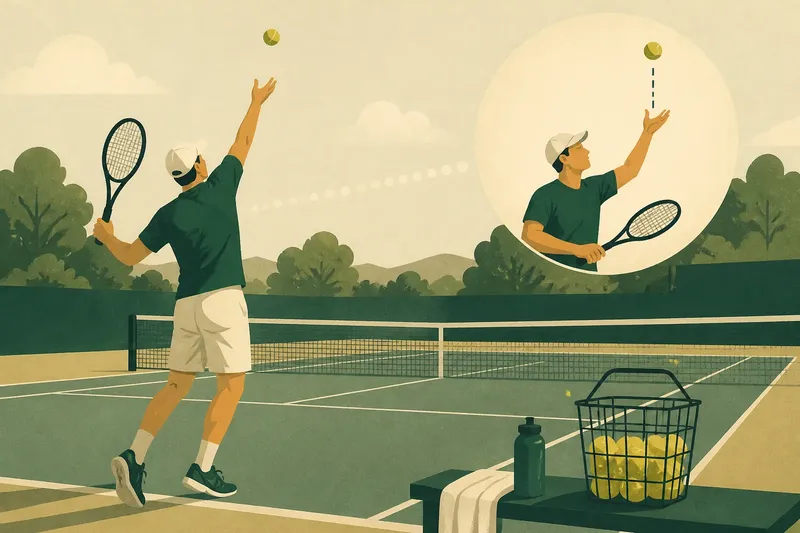
Why does a familiar movement sometimes feel newly awkward the moment you pay attention to it? Why practice changes the way a skill feels is often a matter of where attention lands: one serve becomes a question about the toss, the contact or the finish. That focus can make a repetition easier to read, provided it stays small enough not to crowd out the action.
This does not mean giving every movement a running commentary. Choose something specific to notice, then let the next attempt supply more information. Repetition becomes more than recurrence when it gives you a point of comparison.
Repetition alone can leave a movement hard to read
A complete sporting action contains several linked events. A tennis serve involves a stance, a toss, a turn, a reach and contact with the ball. A basketball free throw has its own preparation, release and follow-through. When a result feels wrong, “do it again” offers another attempt, but not necessarily a clue about what to adjust.
Repeating the whole action without a question can make practice feel busy while leaving the cause of a problem obscure. The ball travels long; the next one does too; the player changes several things at once. If the following attempt improves, it is difficult to know which change mattered. If it worsens, the uncertainty remains, now with a little more irritation.
Attention gives each attempt a point of comparison. You might watch whether the tossing hand releases the ball in a consistent place, or feel whether the front foot stays planted during a kick. The aim is not to diagnose everything. It is to notice one feature that may help explain how the action unfolds.
A small focus makes an attempt easier to interpret
Choose a detail that you can see or feel during the movement, rather than an abstract instruction such as “be better” or “use more power”. Useful details include where the eyes settle, when the wrist turns, how the foot meets the ground, or whether the shoulders rotate before the arm swings. These are possible points of attention, not universal corrections.
A detail is useful when you can answer a plain question about it after an attempt. Did the hand release the ball before or after the arm reached its highest point? Did the racket face feel open or square at contact? Was the landing balanced, or did the body drift sideways? An uncertain observation can still be more informative than a vague verdict about the whole performance.
Say you are learning a badminton clear and the shuttle keeps landing short. You decide to attend only to the sound and feel of contact, rather than changing your grip, footwork and swing together. After one attempt, you notice contact feels rushed while your weight is moving backwards. On the next one, you keep the same focus and look for whether that sensation changes. The result may still vary, but you now have a specific relationship to notice.
A focus should be narrow without becoming a command
Attention can help, but a body does not always respond well to a long list of mechanical orders. “Rotate the shoulder, keep the elbow bent, turn the wrist, brace the trunk, then finish high” is a small committee meeting held at the speed of a volley. Too many instructions can interrupt the rhythm the player is trying to learn.
It helps to distinguish an observation from a command. “My hand feels late” describes a sensation; “snap the wrist harder” prescribes a response. The first leaves room to investigate what is happening. The second may be appropriate in some coaching contexts, but it assumes a cause and remedy before the next attempt has supplied much information.
Some players find it easier to attend to the effect of a movement: the brush of a racket across the ball, the direction a pass leaves the foot, or the sound of a clean strike. Others prefer a bodily cue, such as pressure under the toes or the timing of a breath. Keep the cue that helps you notice the action; discard the one that turns it into a stiff recital.
Practice moves between attention and feel
When learning, a player may consciously inspect one detail. With repetition, that detail can become less prominent, allowing the whole movement to feel more joined up. This is not a switch from thinking to never thinking. Attention can return when a skill changes, conditions differ, or a familiar pattern stops making sense.
For instance, a footballer may first attend to the standing foot during a short pass. Later, the foot placement may feel ordinary, and attention can shift to the weight of the pass or the timing of the first touch. The skill is not being rebuilt from scratch each time. A clearer feel for one part can help the player ask a more useful question about another.
It can be tempting to treat a good-feeling attempt as proof that the right movement has been found. But one clean result may come from a helpful adjustment, a different bounce or ordinary variation. Notice patterns across attempts without demanding that every repetition feel identical. Sporting skill involves responding to changing surfaces, opponents and timing, not manufacturing a single perfect sensation.
Useful questions help you choose what to notice
How do I choose a detail to focus on?
Start with a recurring uncertainty in the action, then choose a detail you can see or feel during one attempt. A coach can help narrow a broad concern into an observable question, especially when the movement is unfamiliar.
How long should I keep the same focus?
Keep it while it produces a useful observation, then pause or change the question if it becomes stale. There is no need to switch after every attempt or cling to a cue that no longer helps you notice anything.
What if I cannot tell whether the movement changed?
Make the question smaller, or use a visible reference such as where a ball lands or which direction a pass travels. If the movement itself is difficult to assess, ask a coach to observe it rather than guessing at a correction.
Should I use the same focus in a match?
A cue that helps in quiet practice may be too demanding when play speeds up. In competition, a brief reminder or attention to the intended result may suit better than monitoring several body parts mid-action.
Feedback should answer a question, not replace attention
A coach’s comment, a partner’s observation or a video clip can make a movement easier to read, but each is most helpful when connected to a particular question. Watching a recording of an entire session may produce plenty of footage and little clarity. Reviewing one short passage to see when the front foot lands, for example, gives the eye a defined job.
External feedback can also be mistaken for certainty. A camera angle may hide the point of contact; a partner may notice the result but not the movement that preceded it. Treat comments as observations to compare with what you felt, not as an automatic verdict. If someone says the follow-through looks rushed, ask what they saw and whether it matches your own sense of the action.
Then return to the movement without the recording or commentary. Feedback is useful when it helps you notice a relationship that you can attend to in later attempts, rather than making practice dependent on a spectator with a phone.
Change the question when the skill changes
A focus that helps in one setting may lose its usefulness in another. A stationary target lets a player attend closely to contact; a moving opponent adds timing and decision-making. A dry court can feel different from a damp one, and a skill performed under pressure may call for a simpler cue than the same action in an empty training space.
When a detail stops helping, do not assume the entire skill has gone backwards. The task may have changed, or attention may have reached the limit of what that cue can explain. Return to the broader purpose of the movement, choose a new observable detail, or ask for another person’s perspective. A small focus is a tool for reading practice, not a rule that every sporting action must be dissected.
To make practice more informative, choose one part of the movement, notice what happens, and let that observation shape the next question. Why practice changes the way a skill feels is not a mystery of repetition alone: attention gives repetition something to teach. Keep the detail modest, and leave enough room for the movement to remain a movement.